A family friendly man cave works when one room is split into zones, seating moves easily, the bar has locked storage and a non-alcoholic side, and the household agrees a few house rules. Done that way, the room stays your favourite spot and everyone else has a reason to come in.
Can a man cave really work for the whole household?
Yes, as long as you plan the room around everyone who will be in it, not only the person who bought the recliner. A man cave that nobody else wants to enter gets used for a few hours a week. A shared one gets used on movie nights, rainy afternoons, game days and the odd Tuesday when someone just wants a sofa that isn’t in the living room.
Most man cave guides assume the room belongs to one person, so they start with the biggest screen and the heaviest leather chair. That works for a solo room. In a home with a partner, kids or housemates, the same room becomes a place the others walk past with a raised eyebrow, or one that slowly fills with their laundry baskets because nobody respects it as a room.
A shared room asks for different decisions, and it helps to answer a few questions before you buy anything:
- Who will use the room, and at what times of day?
- Which activities need to happen there: films, console games, board games, sport, music, homework, a hobby?
- Which items must be kept away from children or guests, such as spirits, tools, breakable collectibles?
- How much noise can the rest of the house tolerate, and when?
- Which bits are non-negotiable for you? Every cave needs a throne, even a shared one.
Write the answers down, even on the back of an envelope. They decide the zones, the seating and the storage in the sections below, and they give you something to point to when someone asks why the dartboard is not above the sofa.
If you are still choosing a theme, colours and the big-ticket items, the man cave ideas guide covers that in detail. This article deals with the part it leaves out: making the room work for more than one person.
How do you split one room into zones everyone can use?
Give each main activity its own corner, so people doing different things are not in each other’s way. Zoning is the most useful habit in a shared room, because it lets a child build a marble run while an adult watches the match without either of them having to move.
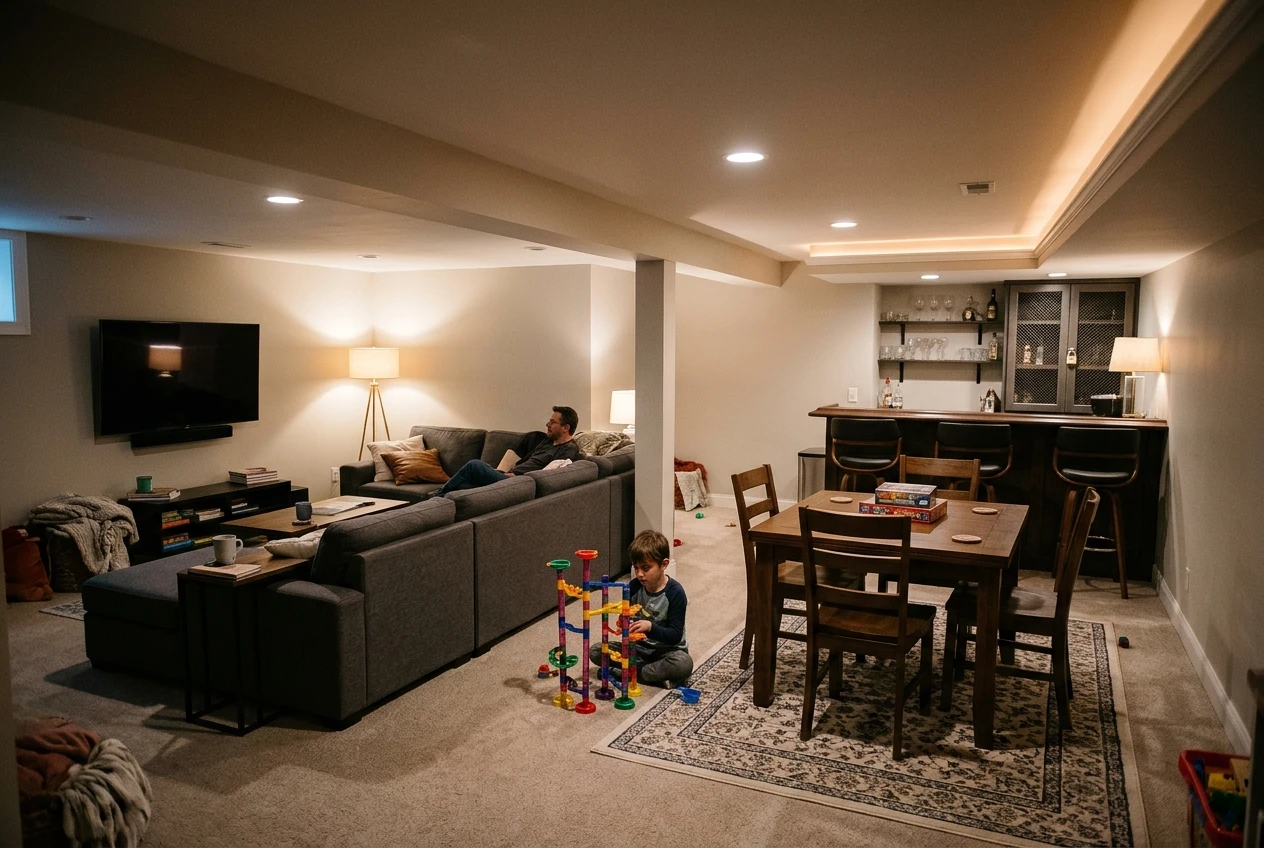
A typical shared room needs three to five zones. Pick the ones that match your answers from the first section:
| Zone | What goes there | Who it suits | Practical tip |
|---|---|---|---|
| Screen zone | TV or projector, main seating, speakers | Movie nights, sport, console games | Put it against the wall with the fewest windows to limit glare |
| Game zone | Table, darts, pool, board games, floor space | Kids, guests, family game afternoons | Keep it clear of the screen sightline |
| Bar zone | Bar cart or counter, fridge, glassware, locked cabinet | Adults, guests | Place it near an exit or the far side from toys |
| Quiet corner | One armchair, a lamp, a shelf | Reading, a call, anyone who needs a break | Face it away from the screen |
| Kid corner | Low storage, a rug, a small table | Younger children | Keep it visible from the main seating |
You do not need all five. A small room might manage the screen zone, a game table that doubles as a homework desk, and a compact bar. The point is that every zone has a clear purpose and a clear boundary.
How to mark the boundaries
Walls are one option, but most rooms do not allow them. These cheaper methods work better:
- Use rugs. A rug under the seating and a different one under the game table tells people where each activity lives.
- Turn furniture into dividers. A sofa with its back to the game zone is a wall that also seats three people.
- Change the lighting. A lamp over the quiet corner and a dimmable strip behind the screen define spaces without anything solid between them.
- Keep the traffic path open. Leave a walkway from the door to every zone. If someone has to step over a pouf to reach the bar, they will stop going to the bar.
Place noisy zones together and quiet ones together. The game table next to the screen zone creates the most noise conflict in any shared room, so put the quiet corner or the bar between them if the floor plan allows.
What seating and layout suit both movie night and a kids’ game afternoon?
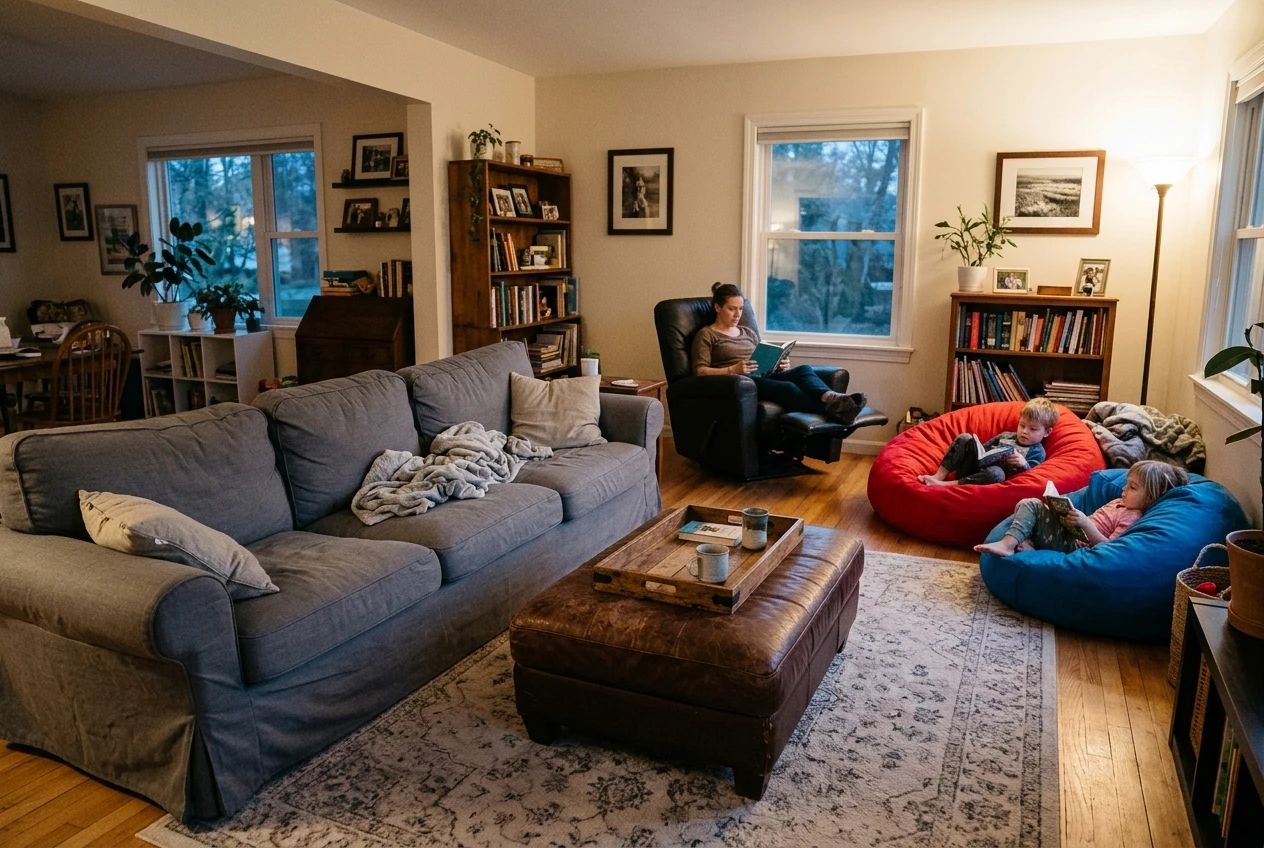
Flexible seating that can face the screen for a film and turn to the table for a game suits both. A fixed row of recliners is great for a film and awkward for everything else, so mix a few permanent pieces with several that move.
A workable seating plan has an anchor, some moveable pieces and a few floor options:
- A sectional or large sofa as the anchor for movie nights. Modular sections can be rearranged, which helps when the room has to change purpose in five minutes.
- One or two recliners or armchairs for whoever has earned them. Decide early whether these are assigned, since seat disputes have ended better rooms than yours.
- Ottomans or poufs that work as footrests, extra seats and, with a tray on top, side tables.
- Bean bags or floor cushions that children can drag wherever they like and that disappear into a corner afterward.
Fabric matters more in a shared room than in a solo one. Choose upholstery that can be wiped or washed, because someone will spill juice, and you will be calm about it only if the sofa forgives. Removable, machine-washable covers or a tightly woven fabric are safer choices than anything delicate.
| Seating option | Good for | Watch out for |
|---|---|---|
| Modular sectional | Movie nights, lounging and rearranging | Needs floor space to reconfigure |
| Recliner | Long films and the adult seat of honour | Footrests can trap small fingers, so check with kids around |
| Ottoman or pouf | Extra seats, footrests and table surfaces | Gets used as a toy, which is fine, but expect it to travel |
| Bean bag | Kids and overflow guests | Can slump and offer little back support for adults |
| Bar stools | Bar zone and game table | Tall seats are poor for younger children, so keep them at the bar only |
Layout for both uses
Face the main seating toward the screen, and leave a gap behind it for a walkway. For a game afternoon, pull the ottomans toward the table and clear the floor between the sofa and the screen so children have space to play. If the room is tight, a game table with a flip or fold-down top can keep the floor open when it is not in use.
Keep the screen at a comfortable height for seated viewing, and keep any wall-mounted TV or tall shelf fixed securely. Children climb on things, and a bolted-down unit is a safer unit.
How do you run a bar in a shared man cave without shutting anyone out?
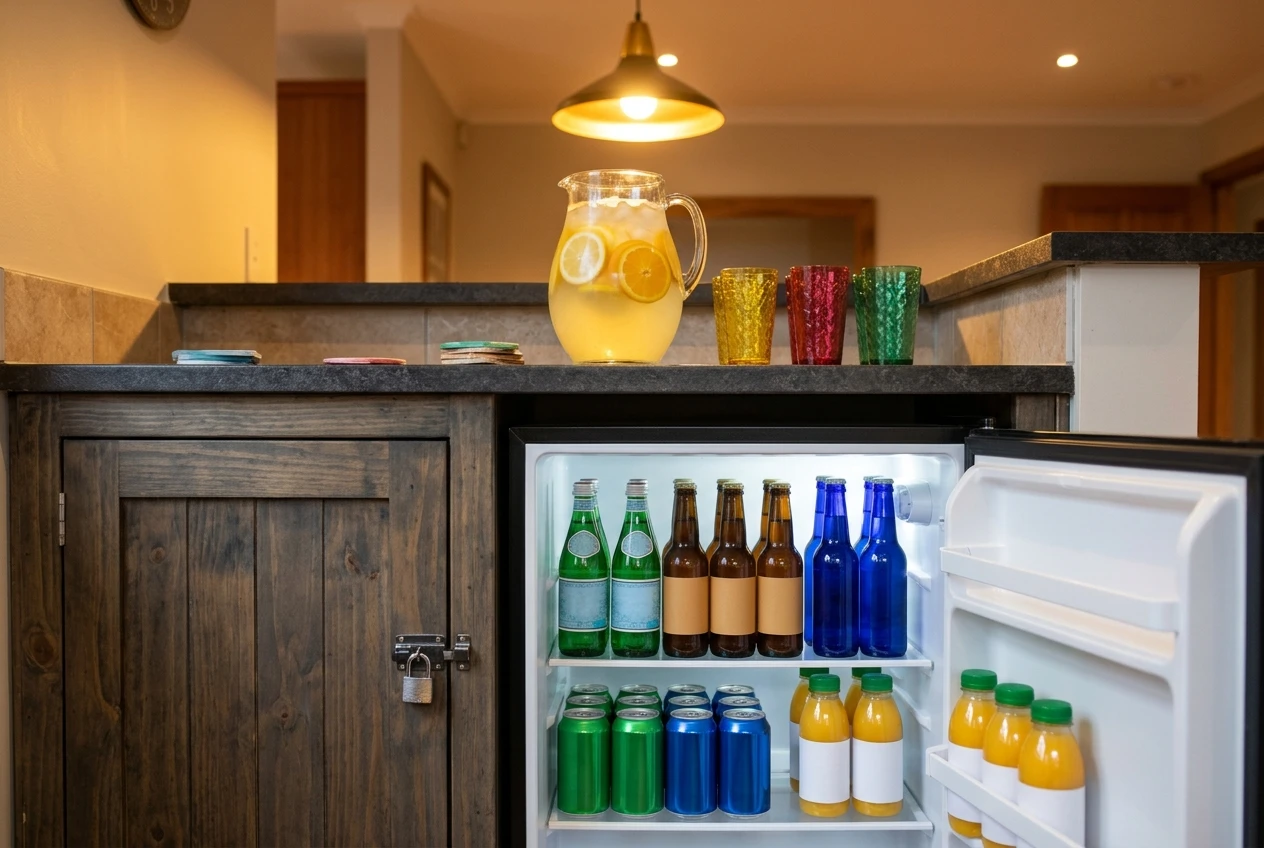
Keep the spirits behind a lock and give the bar a visible non-alcoholic side, so the bar is a place anyone can use and the adult stock is still secure. This is the part of the plan that most often decides whether the room is welcoming or off limits, so it pays to be deliberate.
Lock up the alcohol
A cabinet with a working lock is the simplest answer. Store the bottles, and ideally the stronger mixers and any sharp tools, inside it, and keep the key somewhere children cannot reach or find. A lockable bar cabinet, a bar cart with a locking door, or a fridge with a lock for beer and wine all do the job. Check local rules on alcohol and minors, which vary from place to place, and follow the stricter standard in your own house.
Glassware is the other hazard. Keep glass tumblers and decanters on a high shelf or behind a door, and put unbreakable cups at kid height.
Build a non-alcoholic side
The bar is far more welcome if everyone can order from it. Set aside one end or one shelf of the fridge for drinks that do not contain alcohol:
- Sparkling water, soda and ginger beer
- Juices and a few syrups for flavor
- Non-alcoholic beer or spirits for adults who are driving or do not drink
- Fresh fruit, ice and a few good glasses so a lemonade looks as serious as a negroni
Children enjoy making their own mocktails, and a simple setup with a jug, ice, juice and a spoon is a good Saturday activity. Guests who do not drink will also notice that you thought of them.
Keep the adult stock sensible
A shared room does not need a wall of bottles. A modest starter selection with a whisky, a gin, a vodka, a rum and a tequila covers most classic drinks, and fewer bottles are easier to lock away. If you want guidance on choosing them, our guide to creating the perfect home bar covers layout and stocking in more depth.
Keep the cocktail tools in the locked section too, or at least out of a child’s reach. A cocktail shaker and a jigger are harmless, but the sharper knives and zesters are not.
How do you handle noise, lighting and temperature for different users?
Plan each one separately, because a room that is perfect for a late film can be miserable for a child doing homework at four in the afternoon. Noise, lighting and temperature are the three things that make one person comfortable and another irritable.
Noise
Sound travels, and a man cave is usually where the loud things happen. Decide on volume limits for the hours the rest of the house is asleep or working, and use headphones for late gaming. Rugs, curtains, bookshelves and upholstered furniture all absorb some sound without any building work. For deeper fixes such as sealing gaps and adding insulation, see our guide on how to soundproof a man cave on a budget.
Lighting
Use layers instead of one overhead bulb. A dimmable main light, a couple of lamps and a strip behind the screen let the room shift from bright game afternoon to cinema in a few seconds. Some practical points:
- Put the main light on a dimmer, so it can be bright for children and low for films.
- Add task lighting over the game table and the quiet corner.
- Keep bright fixtures away from the screen to avoid glare.
- Use warm bulbs in the bar zone. Everyone looks better in them, which has never harmed a party.
Temperature
Many man caves sit in basements, garages or converted outbuildings, and those rooms often run colder or hotter than the rest of the house. People also differ in what feels comfortable, so a stack of throws in a basket does more for harmony than an argument over the thermostat. If you add a portable heater or fan, choose one with a tip-over shutoff, keep it away from curtains and furniture, and place it where children cannot knock it or touch it. A fan or a window that opens is often enough in summer, and a rug over a cold floor makes a larger difference than you would expect.
What storage keeps the room tidy and the good stuff safe?
Closed storage at two heights, with kid-level bins for toys and games and high or locked storage for anything valuable, breakable or adult. A room that has a place for everything is much easier to keep tidy, and a shared room gets untidy faster than a solo one.
Think of the storage in three tiers:
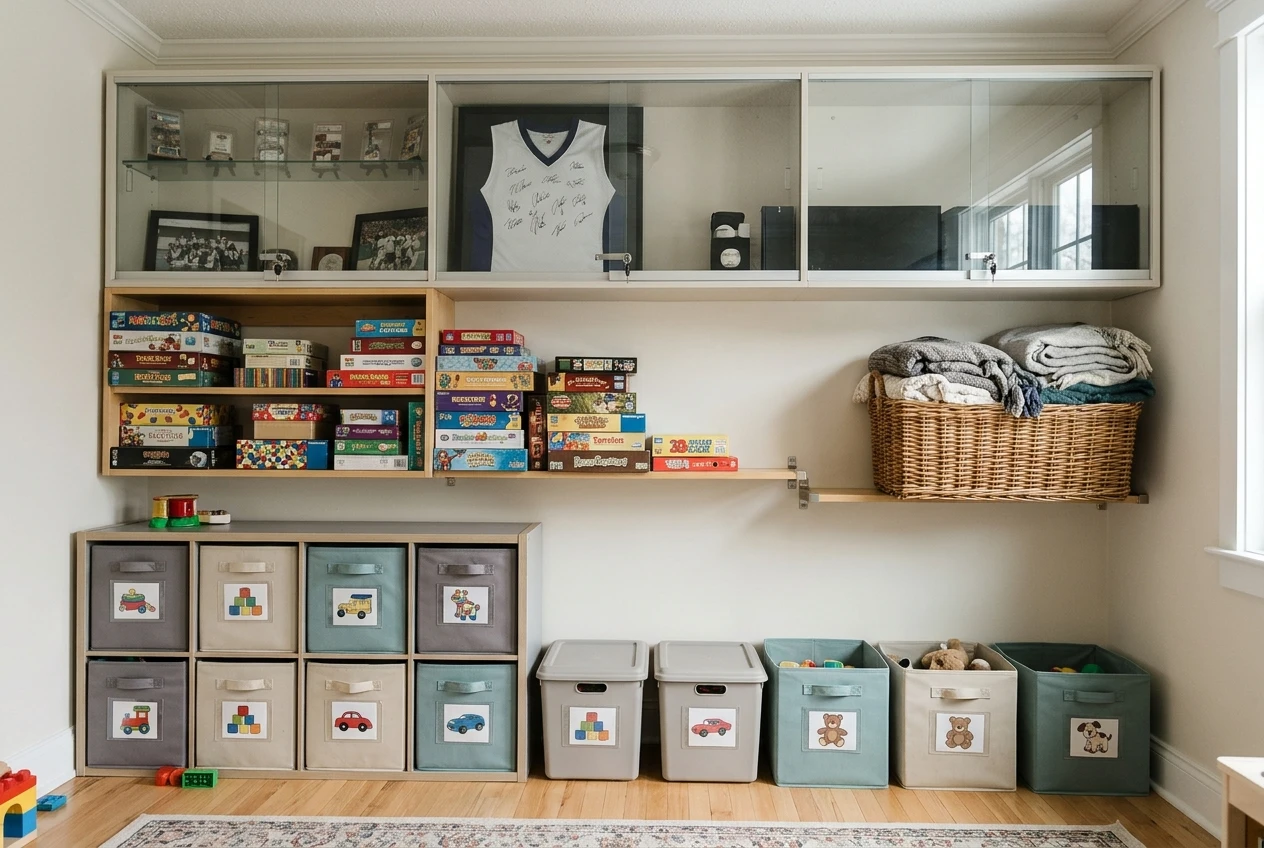
- Low and open for kids. Lidded bins, a toy chest or cubes with fabric drawers at child height. Label them with pictures if the children are young, and they will have no excuse for leaving things on the sofa.
- Mid-level for everyone. Shelves for board games, controllers, remotes and blankets. A basket by the sofa for throws and a tray for remotes stops the daily search.
- High or locked for adults. The bar cabinet, collectibles, display pieces, tools and anything fragile or expensive. A glass-front display case with a lock lets you show off the signed jersey or the limited bottle without it ending up in a toy fight.
A few more habits help:
- Manage the cables. Run them along the wall or inside a cord cover, and keep power strips off the floor where toddlers roam.
- Anchor tall furniture. Bookcases and cabinets should be fixed to the wall so they cannot tip.
- Add a drop spot by the door. A small shelf or basket for keys, shoes and the stray items people bring in prevents the entrance from becoming a pile.
- Rotate the display. Keep a few collectibles on show and the rest in a closed box, so the shelves stay uncluttered.
Wall space is useful in a small room. Floating shelves, a pegboard for game gear and wall-mounted racks for cues or darts all free up the floor, which is the most valuable part of a shared room.
What house rules stop a shared man cave from becoming the family dumping ground?
A short list of agreed rules, written down and applied to everyone including you, keeps the room from filling with other people’s belongings. Without rules, a room with a comfortable sofa and a closing door becomes the place where the ironing, the broken lamp and the bag of outgrown clothes go to wait.
Keep the list short enough that people remember it. Five or six rules is plenty:
- Leave it as you found it. Cups, plates, game pieces and blankets go back before you leave. This applies to the owner of the room as well, and the owner is usually the worst offender.
- The bar lock stays locked. Alcohol is only served by an adult, and the key goes back to its hiding place every time.
- Agree on adult time and family time. Perhaps the room is open to everyone until a set hour, after which it reverts to adult use. Clear hours avoid arguments about whether a film is suitable.
- Take turns with the screen. Whoever booked the slot controls the remote. A simple rota, even a whiteboard on the wall, settles most disputes.
- Food stays in the right zone. Snacks at the bar or table only, so crumbs do not migrate into the sofa.
- No storage for the rest of the house. If an item has been in the room for a week and nobody has claimed it, it goes into a basket by the door. After a month, the basket is emptied.
Agree the rules with the household rather than announcing them. People follow rules they helped write, and children in particular enjoy having a say in a room they will use. Review the list after a month and change whatever is not working.
Rules also give you a polite way to protect your own space. If one chair is yours, say so in the list and enjoy the clarity.